

How Soon Can You Return to Sport After Surgery? A Timeline by Procedure
The short answer
If you're facing surgery for a sports injury, the question on your mind is probably less about the operation and more about the calendar. Will you make the next season? The next race? The next club tournament?
How soon can you return to sport after surgery? Anywhere from about one month to a year or more, depending on the procedure. Operations that remove or tidy damaged tissue, such as a partial meniscectomy, are the quickest. Procedures that repair or rebuild tissue, such as a meniscus repair or shoulder stabilisation, usually take 4 to 6 months. Reconstructions and tendon repairs that must handle big forces, such as ACL reconstruction and Achilles repair, typically take 9 to 12 months.
The timeline below compares the most common sports procedures side by side, then explains why your own return may be faster or slower than the typical range.
Return-to-sport timeline at a glance
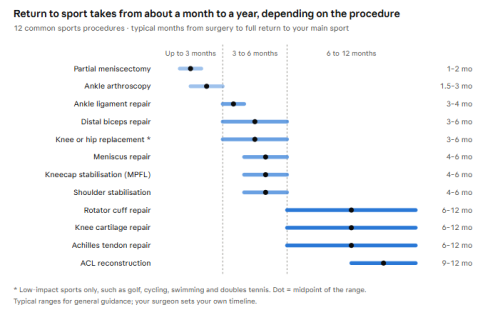
The chart shows the typical time from surgery to playing your main sport at full intensity, sorted from quickest to longest. The darker the bar, the longer the procedure usually takes.
Why some procedures are quicker than others
The procedures in the chart fall into three broad speed tiers. The difference comes down to one question: is the surgeon removing tissue, or asking your body to heal tissue back together?
Up to about 3 months: clean-up procedures
Partial meniscectomy and ankle arthroscopy remove loose or damaged tissue rather than repair it. There's nothing that has to be knit back together, so recovery is limited mainly by swelling, muscle strength and the small keyhole wounds. Most of the time is spent regaining full movement and rebuilding the muscles that switched off after surgery.
3 to 6 months: repairs and stabilisations
Meniscus repair, kneecap stabilisation, shoulder stabilisation, ankle ligament repair and distal biceps repair all involve stitching or anchoring soft tissue back into place. That tissue needs roughly three months to heal strongly enough to take load, and longer before it can cope with sudden twisting, landing or tackling. Joint replacements also sit in this tier, but only for low-impact sports such as golf, cycling, swimming and doubles tennis.
6 to 12 months: reconstructions and major tendon repairs
ACL reconstruction, Achilles tendon repair, rotator cuff repair and cartilage repair need the longest. A new ACL graft goes through a slow remodelling process before it's strong, and the knee must relearn how to control cutting and landing. A repaired Achilles or rotator cuff tendon has to cope with some of the highest forces in sport, from push-off in badminton to a full overhead smash. Cartilage heals slowly because it has very little blood supply.
Your sport changes the clock
"Return to sport" means something very different for a golfer and a rugby player. After the same knee operation, you might be cleared to cycle months before you're cleared to play futsal. Surgeons usually think about sports in four groups:
|
Sport type |
Examples |
What it asks of the joint |
When it usually returns |
|
Low-impact |
Swimming, cycling, golf, gym machines |
Repetitive movement with little impact or twisting |
Earliest, often well before the full range |
|
Straight-line running |
Jogging, road races, park-connector runs |
Repeated impact through the leg, but predictable movement |
Middle of the recovery, once walking and strength are normal |
|
Pivoting, jumping and contact |
Football, futsal, basketball, netball, badminton, rugby, martial arts |
Sudden cutting, landing, lunging and collisions |
Last, at the end of the range |
|
Overhead |
Tennis, badminton smashes, volleyball, swimming butterfly, throwing |
Fast, forceful shoulder movement above head height |
Last for shoulder and elbow procedures |
The chart above shows when most people get back to their main sport, at full intensity. Lower-demand activities usually come back first and can be a useful way to stay fit while you wait.
Five things that move you within the range
Two people can have the same operation on the same day and return to sport months apart. These are the factors that usually make the difference.
- What was found during surgery. A simple tear can turn out to be larger or more complex once the surgeon sees it. Extra work, such as repairing a meniscus during an ACL reconstruction, often adds time.
- Your fitness before the injury and before surgery. People who go into surgery with good strength and full movement tend to recover faster. That's why many surgeons recommend "prehab", a few weeks of targeted exercise before the operation.
- How consistently you do your rehabilitation. Recovery is built in the weeks of physiotherapy and home exercises that follow. Missed sessions and skipped exercises are among the most common reasons people end up at the slow end of the range.
- The level and demands of your sport. A recreational doubles player and a competitive singles player are returning to very different loads. The higher the level, the more strength, speed and confidence you need before you're ready.
- Age, general health and healing. Tendons and cartilage tend to heal more slowly as we get older, and conditions such as diabetes or smoking can slow tissue healing further.
The calendar is only a guide. For major knee procedures in particular, clearance should be based on how the joint performs, which our article on ACL return-to-sport testing covers in detail.
Coming back in stages: the re-entry ladder
Returning to sport isn't a single day when you go from rehab to a full match. The safest comebacks climb a ladder, spending at least a week or two on each rung and only moving up when the last one feels comfortable, with no swelling or pain the next day.
- Solo sport-specific drills. Dribbling, shadow footwork, hitting against a wall, or running your usual routes at an easy pace.
- Non-contact team training. Joining drills with teammates, but without tackles, contested jumps or live play.
- Full training. Everything your teammates do in training, including contact and match-pace intensity.
- Limited match play. A half, a set or a short spell off the bench, building up over several games.
- Full competition. Complete matches and tournaments, ideally with an injury-prevention warm-up you keep doing for the rest of the season.
If any rung brings back pain, swelling or a feeling that the joint isn't stable, step back down one level and speak to your surgeon or physiotherapist before trying again.
Planning your comeback with IOC
Knowing your likely timeline before surgery lets you plan around a season, a race or a tournament instead of guessing.
At International Orthopaedic Clinic, Dr Alan Cheung can talk you through an expected return-to-sport timeline at your sports surgery consultation, from ACL reconstruction and keyhole meniscus surgery to rotator cuff repair. A Senior Consultant Orthopaedic Surgeon with a Diploma in Sport and Exercise Medicine, he has also worked as an appointed doctor for national sports teams and at major sporting events. The clinic offers sports screening for athletes getting ready to compete again.
Have a season or event in mind? Book a consultation at IOC's clinics at Mount Elizabeth Novena or Farrer Park Hospital to map out your surgery and return-to-sport plan. Book a sports surgery consultation or WhatsApp +65 8828 7111.
All timeframes in this article are typical ranges for general information. Your surgeon will set your own timeline based on your surgery, your recovery and your sport